WeRide and Uber Bring Robotaxis to Europe: Madrid and Zurich in 2026
WeRide (NASDAQ: WRD) and Uber are launching their first commercial robotaxi services in Europe — Madrid (announced June 2) and Zurich (announced June 17, 2026). Here's what each deployment involves, the asset-light model behind it, and how it fits their 15-cities-by-2030 plan.
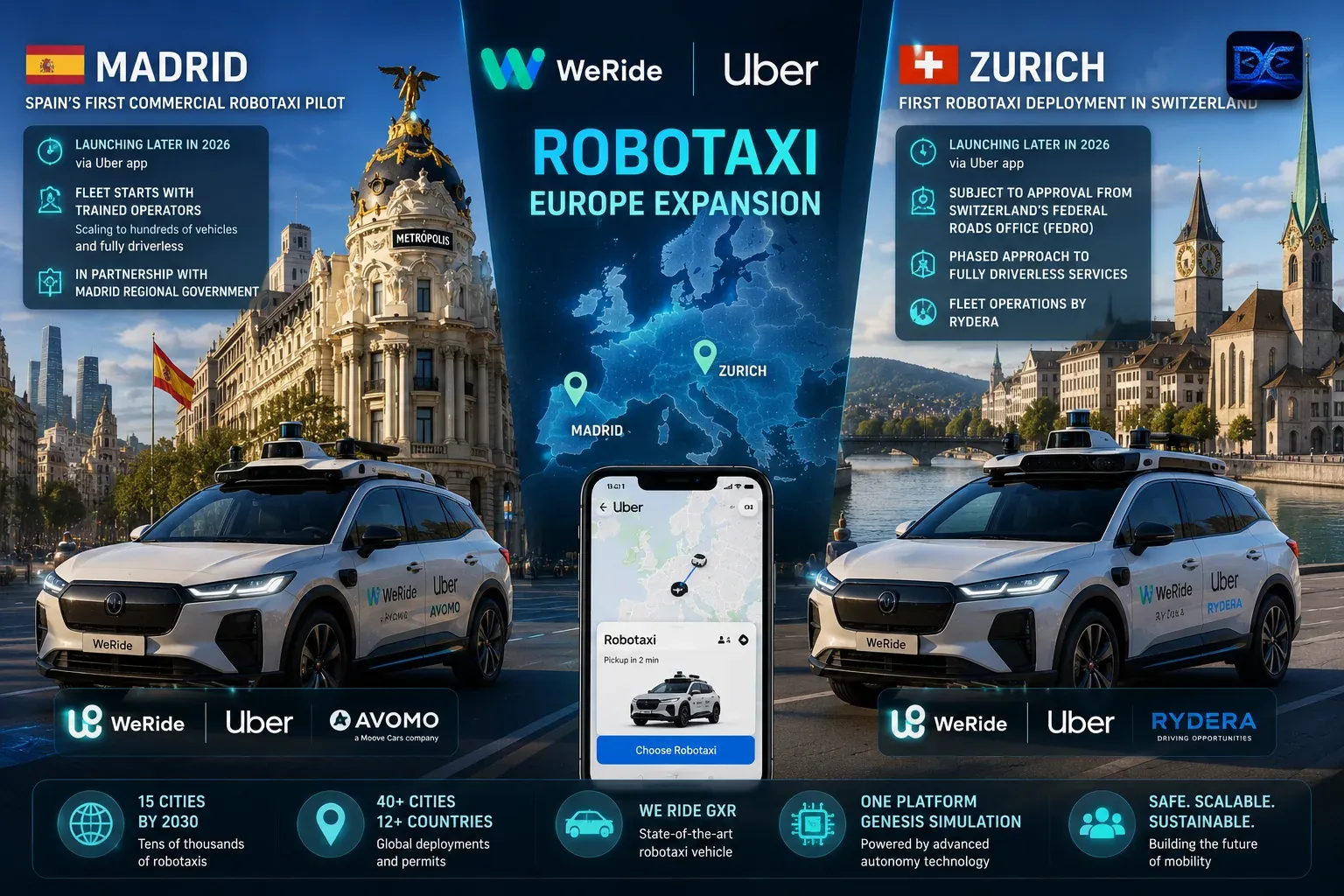
The robotaxi race just opened a European front. WeRide — a Chinese autonomous driving leader (NASDAQ: WRD) — and Uber announced two commercial robotaxi deployments in Europe within weeks of each other: Madrid (June 2, 2026) and Zurich (June 17, 2026). Both will run through the Uber app, with public operations expected later in 2026.
Forward-looking plans. Both launches are subject to regulatory approval, safety-performance milestones, and local coordination. Operations start gradually and scale based on results. Zurich was announced just yesterday — details may still evolve.
Madrid: Spain’s first commercial robotaxi pilot
Announced: June 2, 2026. Partners: WeRide, Uber, and AVOMO — a Moove (Cars Group) company specializing in AV fleet operations. (If you saw this referred to as “Alamo,” AVOMO is the operator that was meant.)
Details:
- Spain’s first commercial robotaxi pilot, in the Region of Madrid.
- Public operations expected later in 2026 via the Uber app.
- Initial phase runs with trained vehicle operators (safety drivers), scaling to hundreds of vehicles and eventually fully driverless in core areas based on performance milestones.
- In collaboration with Madrid’s Regional Government (Comunidad de Madrid).
Significance: the first joint WeRide–Uber entry into the European market, and the fourth city in their global partnership.
Zurich: first deployment in Switzerland
Announced: June 17, 2026. Partners: WeRide and Uber, with Rydera — a local Swiss mobility operator — handling day-to-day fleet operations.
Details:
- Commercial robotaxi services across the Greater Zurich Region, a first for Switzerland.
- Public operations expected later in 2026 via the Uber app, subject to approval from Switzerland’s Federal Roads Office (FEDRO).
- A phased approach: progressive fleet scaling, transitioning to fully driverless in core urban areas.
Significance: the second European deployment, right after Madrid. WeRide already holds a driverless permit in Switzerland (secured in late 2025 for areas like Furttal), which smooths the path.
The bigger partnership
| Detail | |
|---|---|
| Global goal | Robotaxis in 15 cities by 2030, tens of thousands of vehicles |
| Europe | Madrid + Zurich are the first two European cities |
| Elsewhere | Fully driverless in Abu Dhabi/Dubai, public service in Riyadh |
| Vehicle | Primarily the WeRide GXR robotaxi |
| Tech | WeRide’s One universal autonomous platform + GENESIS simulation |
The model is the strategy. WeRide runs asset-light: partners like AVOMO and Rydera own and operate the fleets, while WeRide supplies the autonomous stack and Uber supplies demand and the app. That division of labor is what makes rapid multi-city, multi-country expansion plausible without WeRide carrying every vehicle on its own balance sheet.
Why Europe, and why now
- Demand and pricing. European cities offer strong ride demand and premium pricing — attractive economics for early commercial robotaxi service.
- Progressive regulation in places. Switzerland’s existing driverless permit is a concrete example of a market that’s moved early on rules.
- A global footprint to build on. WeRide reports deployments across 40+ cities in 12+ countries, with permits in 8 markets (including the US, UAE, France, and Switzerland).
Strategically, this puts WeRide and Uber head-to-head with Waymo in the race for scalable commercial robotaxis — and notably plants a Chinese AV leader on European streets through local operating partners.
Takeaway: Madrid and Zurich aren’t full driverless launches on day one — they’re staged commercial pilots that start with safety operators and scale toward driverless as the data earns it. That’s the realistic shape of robotaxi expansion.
What to watch
1. Regulatory gates. Zurich’s public service hinges on FEDRO approval; Madrid coordinates with the regional government. Timelines move with regulators.
2. The operator-partner model. AVOMO and Rydera handling fleets is the template. If it works in Europe, expect WeRide to replicate it city by city toward the 15-by- 2030 target.
3. Safety milestones, not calendars. The transition from safety operators to fully driverless is performance-gated. “Later in 2026” for public ops doesn’t mean driverless on launch day.
Bottom line
WeRide and Uber’s Madrid and Zurich launches mark their first robotaxis in Europe — and the next step in a partnership aiming for 15 cities by 2030. Both start cautiously (safety operators, phased scaling) and run through the Uber app, powered by WeRide’s autonomous platform and local fleet operators.
These are real commercial moves, but they’re early and conditional. For the authoritative timeline, check Uber Investor Relations or WeRide IR as approvals and rollouts firm up.
Sources: WeRide and Uber announcements for Madrid (June 2, 2026) and Zurich (June 17, 2026), plus WeRide’s disclosed global footprint. Plans are subject to regulatory approval and safety performance; verify current status before relying on it.
Related articles

Uber Picks Houston for Its Premium Robotaxi Service in 2027
Uber, EV maker Lucid, and self-driving company Nuro are bringing a premium robotaxi service to Houston by mid-2027. Here's the plain-English breakdown: the cars, the tech, the timeline, and how it stacks up against Waymo.
Waymo's ~4,000-Robotaxi Recall: It Was Floods, Not Construction Zones
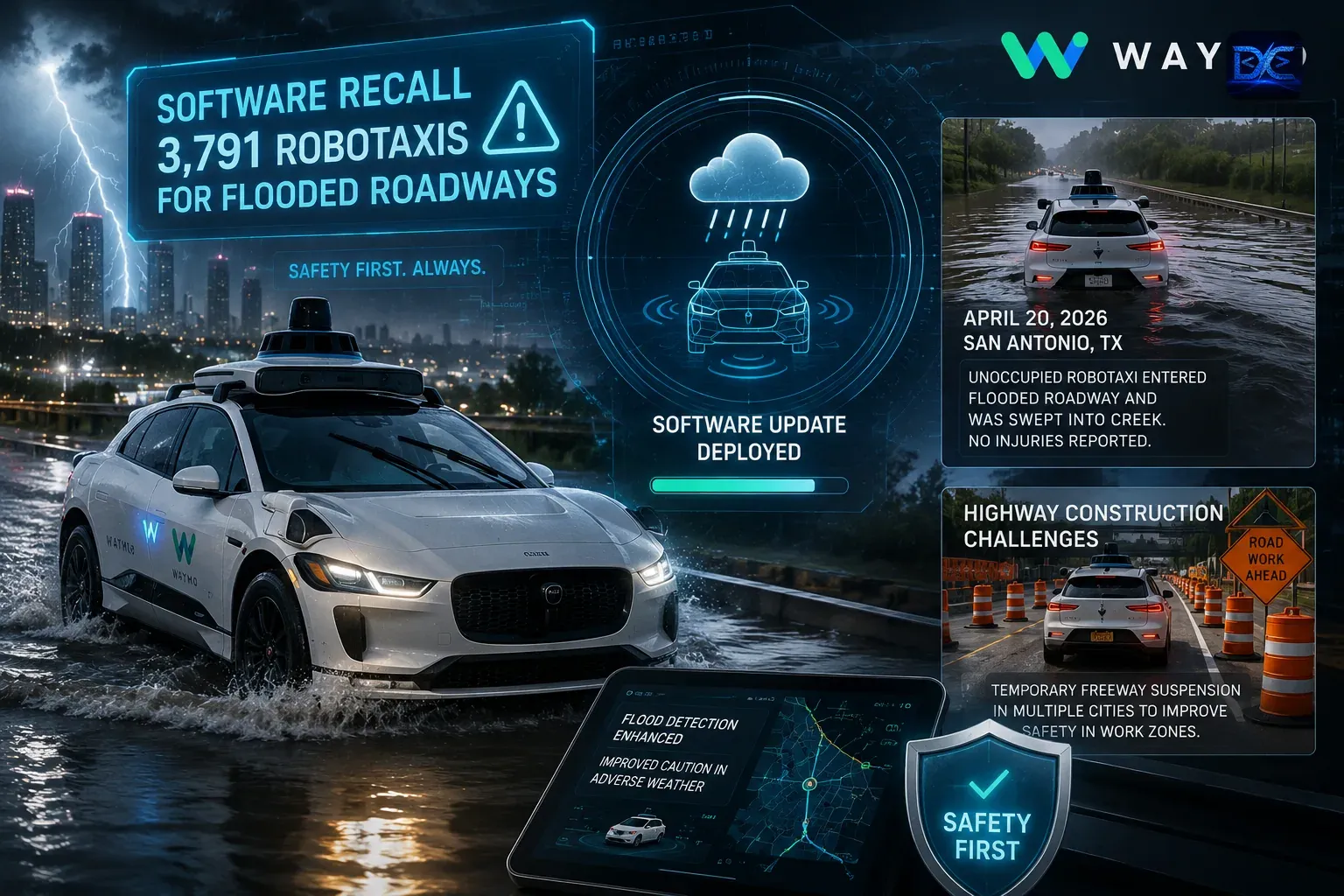
There's real confusion mixing up two separate Waymo safety actions from May 2026. The recall of nearly 4,000 robotaxis was a flooded-roadway software issue filed with NHTSA — not the freeway construction-zone pause. Here's the accurate, side-by-side breakdown.

VivaTech 2026: Europe's Biggest Tech Event Turns 10, With AI Sovereignty Front and Center
VivaTech 2026 — Europe's largest startup and tech event — runs June 17–20 in Paris for its 10th anniversary edition. The theme is 'Artificial Intelligence: Impact, Not Illusion,' and the backdrop is Europe's push for tech sovereignty amid U.S. AI dominance. Here's a Day One rundown.
Have a project or an idea?
We don't just write about software — we build it. Tell us what you're working on and we'll get back within 1–2 business days.