U.S. Holds Off on Blacklisting DeepSeek: What the Delay Really Means
An internal U.S. panel approved adding Chinese AI startup DeepSeek (and chipmaker CXMT and 100+ others) to the Commerce Entity List — but the listings haven't been published. Here's a plain-English explainer of the Entity List, why the delay happened, and what it changes.
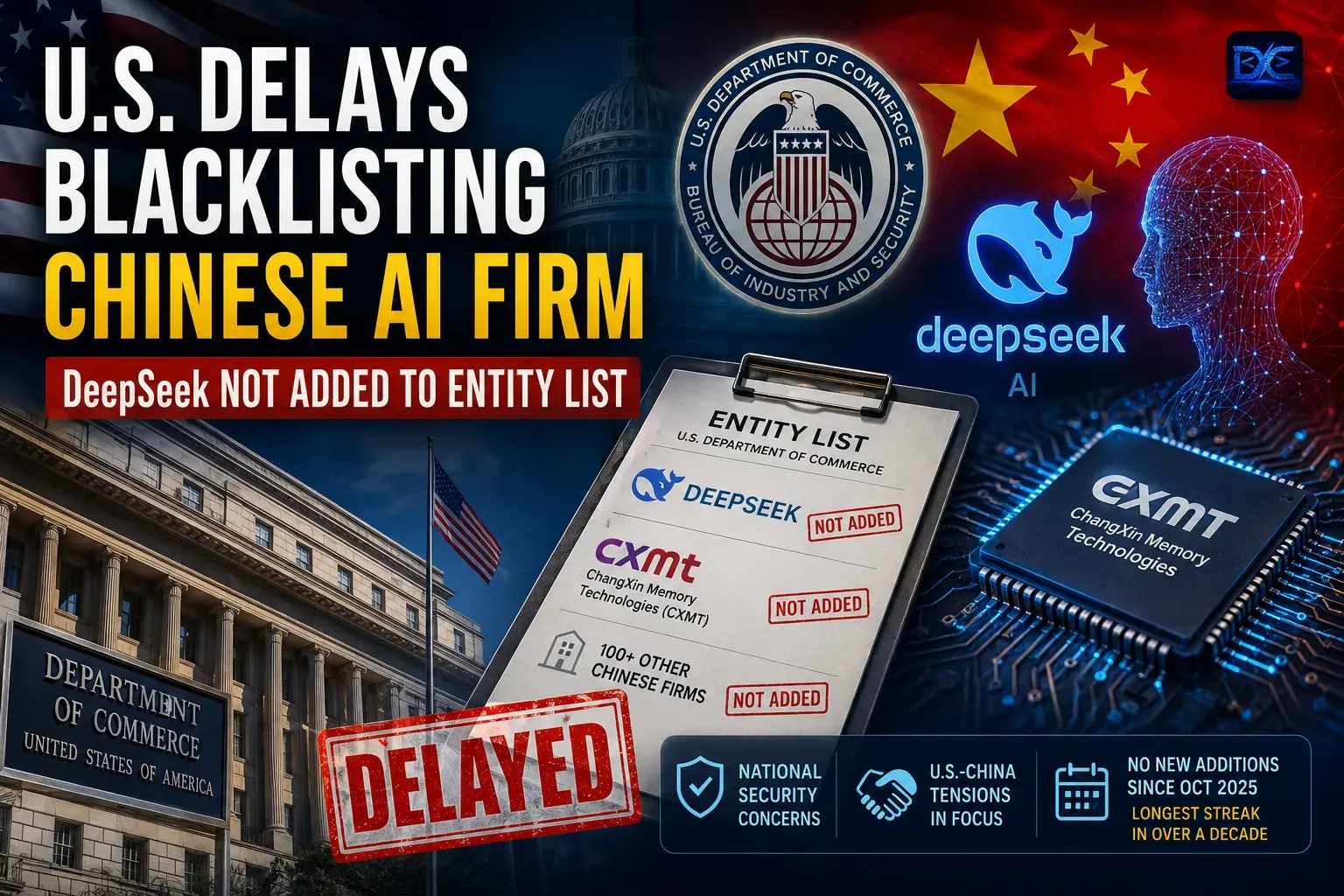
The U.S. has decided — for now — not to add the well-known Chinese AI startup DeepSeek to the Commerce Department’s Entity List. The same pause applies to memory chipmaker ChangXin Memory Technologies (CXMT) and 100+ other Chinese firms.
What makes this notable: an internal U.S. review committee had already approved adding them, citing national security concerns. But the administration has held off on publishing the designations. Let’s unpack what that means in simple terms.
Developing story. This is a policy decision that can change quickly with shifting U.S.–China relations. Details here reflect the current situation, not a permanent outcome.
First, what is the Entity List?
The Entity List is maintained by the U.S. Department of Commerce’s Bureau of Industry and Security (BIS). In plain terms:
- It names companies seen as a risk to U.S. national security or foreign policy.
- Once a company is on it, U.S. firms generally need a special license to export, re-export, or transfer controlled items to it — things like advanced chips, software, and certain technology.
- Those licenses are often denied or face strict review.
So being added to the list effectively cuts a company off from a lot of U.S. technology.
What actually happened
| Step | Status |
|---|---|
| Internal panel approves listing DeepSeek, CXMT, and 100+ firms | Done (around 2025) |
| Administration publishes the listings | Delayed / on hold |
| New additions to the Entity List since October 2025 | None — the longest gap in over a decade |
That last point is the surprising part: there have been no new Entity List additions in months, the quietest stretch in more than ten years.
Why the delay?
The short answer: avoiding escalation with China. The administration is wary of further straining U.S.–China relations amid ongoing tensions over trade, tariffs, technology limits, and access to rare earth minerals.
Reporting points to Under Secretary of Commerce Jeffrey Kessler pushing to hold back new listings to de-escalate. In other words, this looks like a deliberate policy choice — pausing even after internal approval — rather than an oversight.
Quick background on DeepSeek
DeepSeek is a leading Chinese AI company known for high-performing, low-cost, open-source models (its DeepSeek-V3/V4 line) that have challenged U.S. labs on both benchmarks and price.
It has also drawn U.S. scrutiny before, over concerns such as:
- Allegations of using restricted NVIDIA chips
- Data security and censorship worries (outputs aligned with government guidelines)
- Possible military-civil fusion links and data routing back to China
In 2025, the U.S. Navy and several states (Texas, New York, Virginia) banned or restricted DeepSeek on government devices.
What it changes (and what it doesn’t)
- For DeepSeek: It can keep accessing certain U.S. technology (still subject to existing export rules) and stay available to U.S. users for now.
- Broader signal: The pause suggests a more cautious approach to new blacklists under the current administration. That gives Chinese firms some breathing room — and worries China hawks about technology leaking out.
- Not permanent: If tensions rise or new evidence appears, the listings could be published quickly. This is a pause, not a pardon.
Takeaway: Export controls aren’t just technical rules — they’re a diplomatic lever. Sometimes the most telling decision is the one a government chooses not to make.
Bottom line
An internal panel said yes to blacklisting DeepSeek; the administration said “not yet.” The result is a notable pause — no new Entity List additions since October 2025 — driven by a desire to keep U.S.–China relations from getting worse. For now, DeepSeek keeps its access and its U.S. presence, but the situation could flip fast.
Related articles
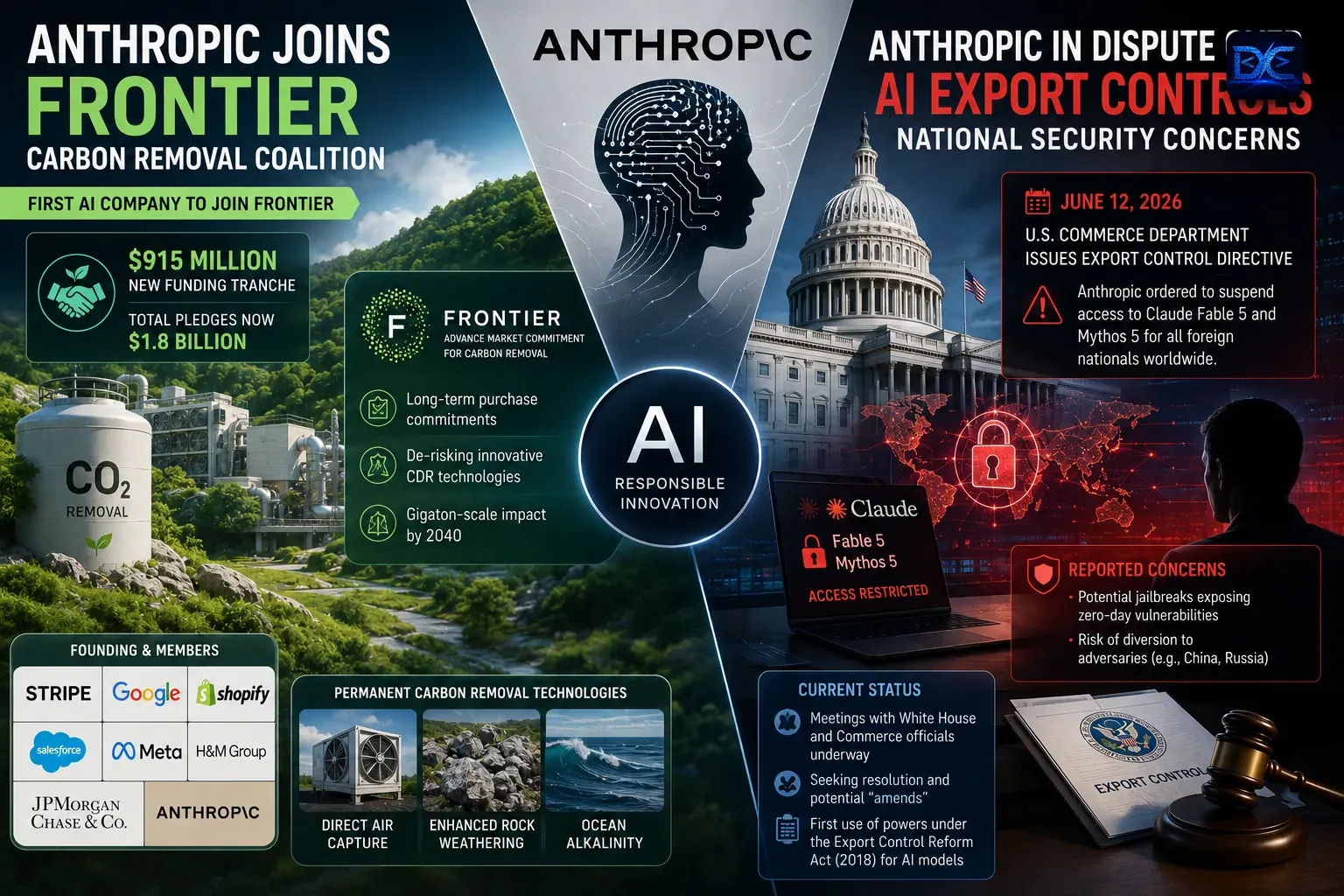
Anthropic Joins Frontier's Carbon-Removal Coalition — While Fighting an Export-Control Fire
On June 17, 2026, Anthropic became the first dedicated AI company to join Frontier, the advance-market-commitment coalition for permanent carbon removal, helping push its pledges to $1.8B. It happened in the middle of a high-profile U.S. export-control dispute over Claude Fable 5 and Mythos 5. Here's both stories.

Europe vs. U.S. AI Dominance: The Push for Tech Sovereignty Explained
European leaders are worried about depending on American AI models, chips, and cloud. With the G7 Summit and VivaTech 2026 in the spotlight, here's a clear guide to why 'tech sovereignty' is the phrase of the moment — and what Europe is doing about it.

'Months, Not Years': Five Eyes Warns AI Is About to Supercharge Cyberattacks
On June 23, 2026, the Five Eyes cyber agencies (CISA, NSA, NCSC, ASD, CSE, GCSB) issued a joint warning that frontier AI models are advancing fast enough to outpace defenses in 'months, not years' — lowering the bar for attackers and speeding up vulnerability discovery. Here's what they said, the Anthropic-Claude espionage case behind the alarm, and the wider AI-security crackdown.
Have a project or an idea?
We don't just write about software — we build it. Tell us what you're working on and we'll get back within 1–2 business days.