Europe vs. U.S. AI Dominance: The Push for Tech Sovereignty Explained
European leaders are worried about depending on American AI models, chips, and cloud. With the G7 Summit and VivaTech 2026 in the spotlight, here's a clear guide to why 'tech sovereignty' is the phrase of the moment — and what Europe is doing about it.

A big debate is heating up in Europe: how much should the continent depend on American companies for its AI? European leaders and policymakers are increasingly uneasy about relying on U.S. firms for AI models, cloud services, and chips — and the topic is taking center stage at two major events in France: the G7 Summit (Évian) and VivaTech 2026 (Paris).
The core idea is technological sovereignty — Europe’s ability to control its own digital future instead of being at the mercy of decisions made elsewhere. Here’s a simple breakdown of the worry, the response, and the challenges.
Context: This is a policy story that’s still developing. Specific programs, figures, and timelines may evolve as summits conclude and proposals turn into law. Use this as a map of the debate, not a final scorecard.
Why Europe is worried
The concern boils down to dependence. Much of Europe’s AI stack is built on American foundations:
- AI models from companies like OpenAI, Google, and Anthropic
- Chips, especially NVIDIA’s GPUs that train and run AI
- Cloud infrastructure from AWS, Microsoft Azure, and Google Cloud
That dependence becomes risky when U.S. policy changes. Recent U.S. restrictions on access to advanced AI models highlighted how a foreign policy decision could suddenly limit what European companies can use.
Layer in global competition with both the U.S. and China, and the stakes touch critical areas like healthcare, energy, and defense — sectors no country wants to outsource entirely.
The regulation vs. innovation gap
There’s also a difference in approach. Europe has focused heavily on rules — the AI Act and GDPR — while the U.S. has prioritized speed and scale. Good rules build trust, but if Europe can’t also build competitive AI, it risks writing the rulebook for technology it doesn’t own.
Europe’s response: building its own stack
Europe isn’t just complaining — it’s spending and legislating. The headline efforts:
A major investment push (InvestAI / AI Continent plan): a roughly €200 billion initiative to grow homegrown AI, including:
- Funding for up to 5 AI “gigafactories” (huge compute hubs)
- 19 AI factories to support startups and industry
- A focus on compute, data access, talent, and real-world AI adoption
A Tech Sovereignty Package, which includes:
- Chips Act 2.0 — boost local semiconductor manufacturing and reduce reliance on non-EU suppliers
- Cloud and AI Development Act (CADA) — make it easier to build data centers and promote sovereign cloud/AI options
- An open-source strategy and incentives for domestic innovation
Political leadership from France and Germany, with strong calls for “strategic autonomy” — the ability to act independently on critical tech.
The two events in focus
| Event | Why it matters |
|---|---|
| G7 Summit (Évian) | Leaders and AI executives discuss competitiveness, regulation, critical minerals, and reducing over-reliance on U.S. tech — while staying cooperative. |
| VivaTech 2026 (Paris) | Europe’s flagship tech event (180,000+ attendees) showcasing enterprise AI, industrial use, and a distinct European model: regulation, transparency, and privacy. |
The contrast on display: Europe’s emphasis on trust, transparency, and real-world applications versus the U.S. style of pure speed and scale.
The honest challenges
Sovereignty is easier to announce than to achieve. Europe faces real hurdles:
- Scale. Homegrown champions like Mistral are promising but still small compared to U.S. giants.
- Funding gaps. U.S. private investment in data centers and models runs into the hundreds of billions — hard to match with public programs alone.
- Talent and energy. Keeping top researchers and powering massive AI training both require serious, sustained investment.
What it means for you
- For European businesses: Expect more sovereign cloud and local-AI options, but plan for a transition period where U.S. tools remain dominant.
- For developers everywhere: Portability matters. Build so you can switch models, clouds, or chips without rewriting everything. Open standards and abstraction layers are your insurance.
- For the industry: The “one global AI supply chain” assumption is fading. Expect more regional stacks, rules, and incentives.
Takeaway: “Tech sovereignty” isn’t anti-American — it’s about not having a single point of failure. The practical lesson for builders is the same at any scale: avoid lock-in and keep your options open.
Bottom line
Europe wants to stay allied with the U.S. while controlling its own critical technology. It’s backing that goal with big money (around €200 billion) and new laws like Chips Act 2.0 and CADA. Whether it can close the scale and funding gap is the open question — and the G7 and VivaTech are where that conversation is happening right now.
Related articles

'Months, Not Years': Five Eyes Warns AI Is About to Supercharge Cyberattacks
On June 23, 2026, the Five Eyes cyber agencies (CISA, NSA, NCSC, ASD, CSE, GCSB) issued a joint warning that frontier AI models are advancing fast enough to outpace defenses in 'months, not years' — lowering the bar for attackers and speeding up vulnerability discovery. Here's what they said, the Anthropic-Claude espionage case behind the alarm, and the wider AI-security crackdown.

Oracle Cuts ~21,000 Jobs in a Year as AI Reshapes the Workforce
Oracle shed roughly 21,000 roles — about 13% of its workforce — over the past year, its largest-ever one-year cut, as it leans into AI and pours money into AI infrastructure. Headcount fell from ~162,000 to ~141,000, with $1.84B in restructuring costs. Here's who was cut, who was spared, and what it signals.
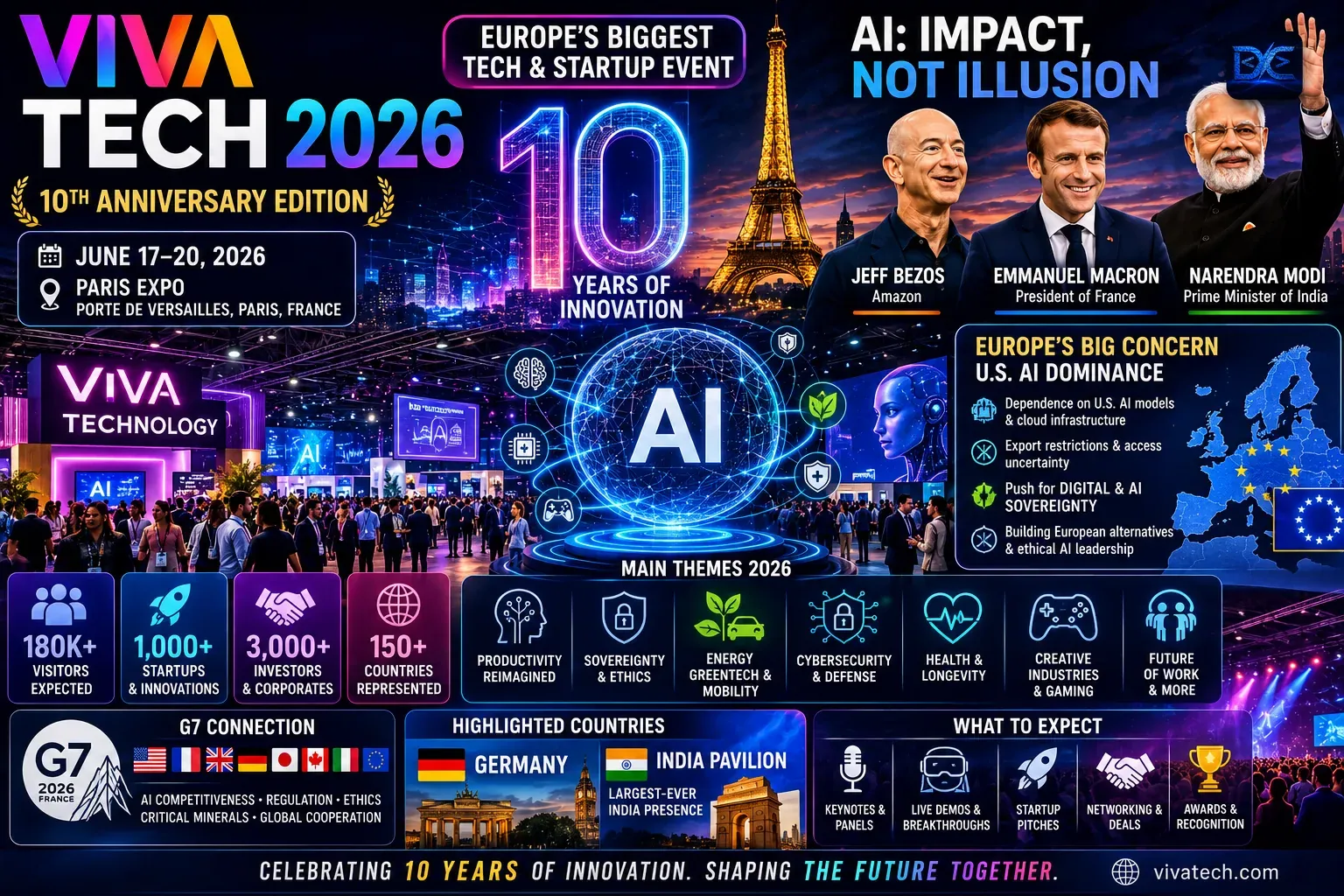
VivaTech 2026: Europe's Biggest Tech Event Turns 10, With AI Sovereignty Front and Center
VivaTech 2026 — Europe's largest startup and tech event — runs June 17–20 in Paris for its 10th anniversary edition. The theme is 'Artificial Intelligence: Impact, Not Illusion,' and the backdrop is Europe's push for tech sovereignty amid U.S. AI dominance. Here's a Day One rundown.
Have a project or an idea?
We don't just write about software — we build it. Tell us what you're working on and we'll get back within 1–2 business days.