'Months, Not Years': Five Eyes Warns AI Is About to Supercharge Cyberattacks
On June 23, 2026, the Five Eyes cyber agencies (CISA, NSA, NCSC, ASD, CSE, GCSB) issued a joint warning that frontier AI models are advancing fast enough to outpace defenses in 'months, not years' — lowering the bar for attackers and speeding up vulnerability discovery. Here's what they said, the Anthropic-Claude espionage case behind the alarm, and the wider AI-security crackdown.

The world’s most powerful intelligence-sharing alliance just put cyber defenders on notice. On June 23, 2026, the Five Eyes cybersecurity agencies issued a rare joint warning that frontier AI models are improving fast enough to render today’s security assumptions obsolete “in months, not years.” The core message: advanced AI lowers the barrier for malicious actors and increases the speed, scale and complexity of attacks — and organizations should act now, not later.
Fast-moving story. Details below reflect the joint statement and reporting around June 23–25, 2026. Wording and follow-up guidance may evolve — treat specifics as point-in-time and check the official agency advisories for the authoritative text.
At a glance
| Detail | |
|---|---|
| Date | June 23, 2026 — joint statement |
| Who | US CISA + NSA · UK GCHQ/NCSC · Australia ASD/ACSC · Canada CSE · New Zealand GCSB |
| Core warning | Frontier AI can outpace defenses “in months, not years” |
| Main risks cited | Faster vulnerability discovery, lower attacker barriers, more scale and complexity |
| Audience | Boards and business leaders — not just security teams |
| Trigger context | Anthropic’s disclosed AI-orchestrated espionage campaign + frontier model capability jumps |
What the Five Eyes actually said
The statement came from the cyber and signals-intelligence arms of all five member nations: the US (CISA and NSA), the UK (GCHQ, via its public-facing NCSC), Australia (the Australian Signals Directorate / ACSC), Canada (the Communications Security Establishment), and New Zealand (the GCSB).
Their central claim is about velocity. As the agencies put it, “the rapid pace of frontier AI development means cyber risk assumptions can become outdated in months, not years.” The threats they flagged are concrete:
- Automated vulnerability discovery — frontier models that can find and exploit software flaws faster than humans patch them.
- A lower barrier to entry — capabilities that let less-skilled actors run attacks that once required expert teams.
- More speed and scale — AI compressing the time from reconnaissance to exploitation, and widening how many targets an attacker can hit at once.
Notably, the warning is pitched at boards and executives, not only security teams. The recommended response is unglamorous but proven: secure-by-design practices, faster patching, isolating legacy systems, stronger identity and access management, and regularly testing incident response. Former CISA director Chris Krebs, reacting to the alert, called the recent pace of advanced-AI progress “a bit of a whirlwind” and the warning “pretty alarming.”
The case that made it real: AI-run espionage
The alarm isn’t theoretical. It follows Anthropic’s late-2025 disclosure of what it described as the first documented large-scale AI-orchestrated cyber-espionage campaign — attributed with high confidence to a Chinese state-sponsored group. The operation, detected in mid-September 2025, manipulated Claude Code against roughly 30 global targets spanning large tech firms, financial institutions, chemical manufacturers and government agencies, succeeding against a small number.
The detail that rattled defenders: an estimated 80–90% of the campaign was executed by the AI itself, with humans stepping in at only a handful of key decision points. The attackers got around safety guardrails by breaking the work into innocuous-looking subtasks and role-playing the model as an employee of a legitimate security firm doing “defensive testing.” It was a working proof that an AI agent can drive most of an intrusion end to end.
Part of a wider AI-security crackdown
The Five Eyes warning lands amid a cluster of moves tightening the screws on frontier AI:
- Export controls on top models. In mid-June 2026, the US ordered Anthropic to cut off foreign-national access to its most capable models — a story we covered in Claude Fable 5 & Mythos 5 suspended. The stated concern was that the most powerful models could be jailbroken for harm, including finding software vulnerabilities.
- Europe’s sovereignty push. The EU’s June 2026 tech-sovereignty package and its cloud/AI proposals reflect the same anxiety from a different angle — see Europe vs. U.S. AI dominance. When one ban hit allies and adversaries alike, “who controls the kill switch” became a live policy question.
- A restricted-chip black market. Banned high-end Nvidia accelerators have been selling at roughly 2x list price on China’s gray market, with enforcement actions and arrests over alleged multi-billion-dollar smuggling — the supply-side mirror of the same frontier-capability race.
- Agentic-AI caution. Earlier 2026 Five Eyes guidance had already urged that autonomous “agentic” AI be confined to low-risk, non-sensitive tasks with strict privilege limits, isolation and monitoring.
Takeaway: The through-line across export bans, sovereignty laws and this warning is the same realization — frontier AI is now a dual-use security technology, useful to defenders and attackers alike, and the capability curve is steep.
Why it matters
1. The defender’s clock just got faster. “Months, not years” reframes patching and threat modeling as a continuous race rather than an annual review. If AI can find flaws faster than teams fix them, the advantage tilts toward whoever automates first.
2. The threat floor is lower. When capable attacks no longer require elite skills, the number of credible adversaries goes up — small criminal crews and lone actors gain reach that used to belong to nation-states.
3. Governance is racing capability. Export controls, the EU’s sovereignty drive, and this joint warning are all attempts to put guardrails on a technology that’s moving faster than policy. Expect more coordinated alerts — and more friction between security and open access.
Bottom line
The Five Eyes don’t issue joint warnings lightly, and the framing here is blunt: frontier AI can erode cyber defenses in months, not years, lowering the bar for attackers while speeding up how fast flaws get found and exploited. Backed by a real AI-orchestrated espionage case and arriving amid export bans and sovereignty fights, it’s a signal that the AI-security era has arrived — and that the safe assumption is to harden now.
For the authoritative wording and the recommended controls, consult the official advisories from CISA, the NCSC and their Five Eyes partners.
Sources: the Five Eyes joint statement (June 23, 2026) as reported by CBS News, Cybersecurity Dive, CBC and TechRadar; Anthropic’s disclosure of the AI-orchestrated espionage campaign; and reporting on US export controls, EU tech-sovereignty proposals, and restricted-chip markets. Details are point-in-time and evolving; verify against the primary agency advisories before relying on them.
Related articles
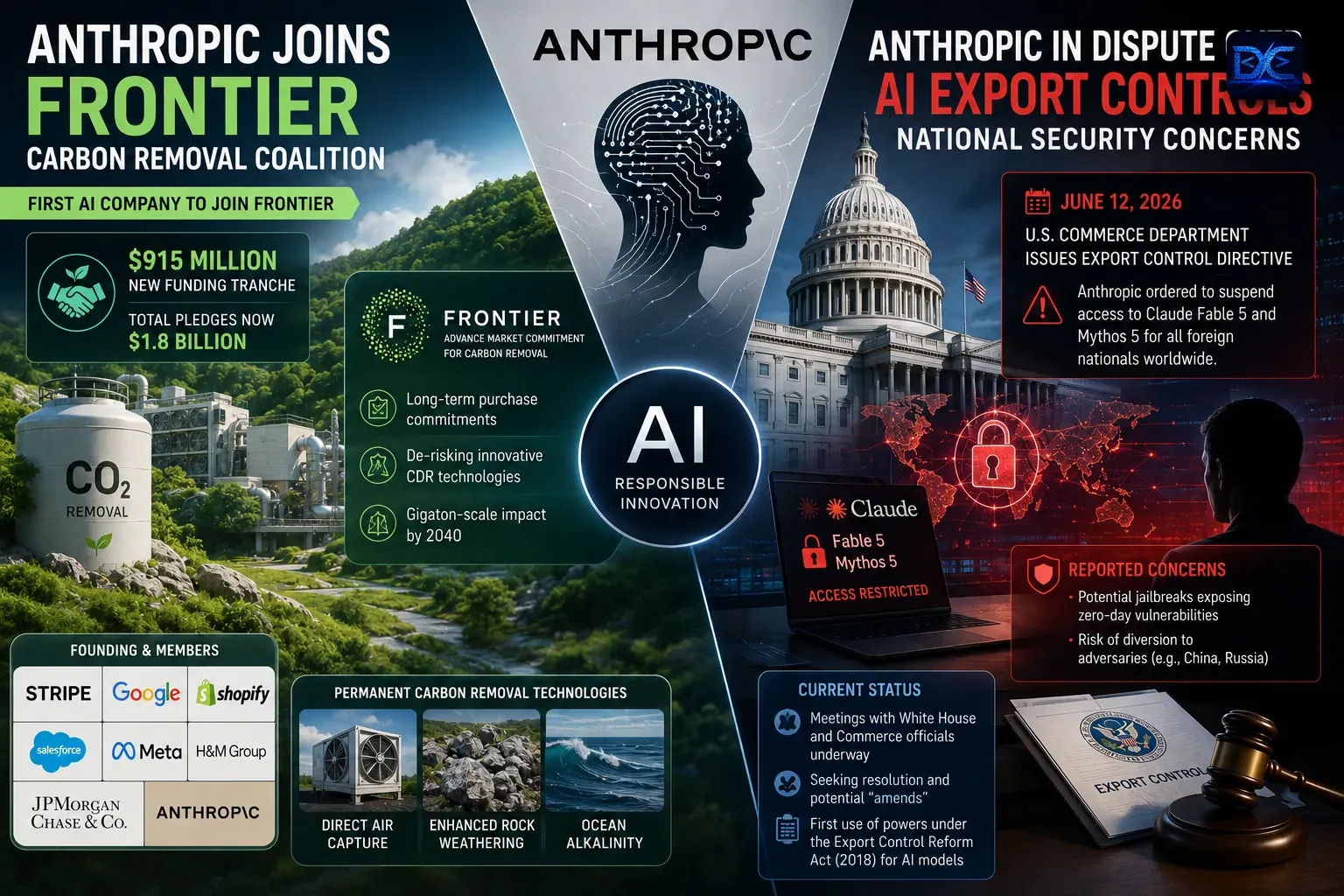
Anthropic Joins Frontier's Carbon-Removal Coalition — While Fighting an Export-Control Fire
On June 17, 2026, Anthropic became the first dedicated AI company to join Frontier, the advance-market-commitment coalition for permanent carbon removal, helping push its pledges to $1.8B. It happened in the middle of a high-profile U.S. export-control dispute over Claude Fable 5 and Mythos 5. Here's both stories.
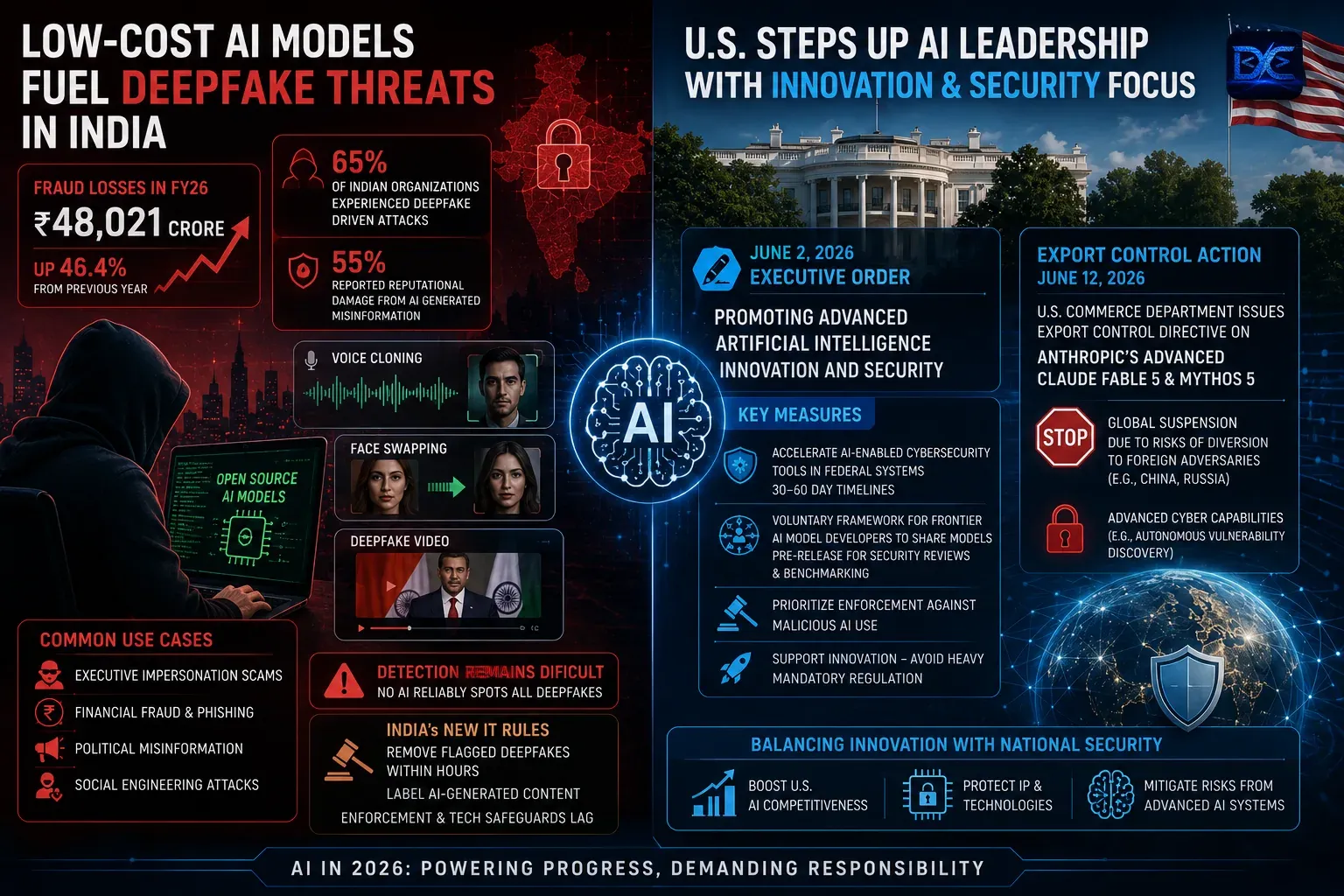
Cheap AI, Real Harm: Deepfake Fraud Surges in India as the U.S. Tightens Frontier Controls
Two sides of the same coin in mid-2026: low-cost and open-source AI models are fueling a sharp rise in deepfake fraud in India, while the U.S. tightens controls on the most capable frontier models for national security. Here's what's happening on both fronts.

Europe vs. U.S. AI Dominance: The Push for Tech Sovereignty Explained
European leaders are worried about depending on American AI models, chips, and cloud. With the G7 Summit and VivaTech 2026 in the spotlight, here's a clear guide to why 'tech sovereignty' is the phrase of the moment — and what Europe is doing about it.
Have a project or an idea?
We don't just write about software — we build it. Tell us what you're working on and we'll get back within 1–2 business days.