Apple Pulls the Trigger: Macs, iPads and More Get Pricier — iPhone Spared (For Now)
On June 25, 2026, Apple raised prices across Macs, iPads, the HomePod, Apple TV and Vision Pro — citing an AI-driven 'hundred-year flood' in memory and storage chip costs. The iPhone, Apple Watch and AirPods were spared. AAPL fell ~5%. Here's the full price list, why memory hit Macs hardest, and the context behind the move.
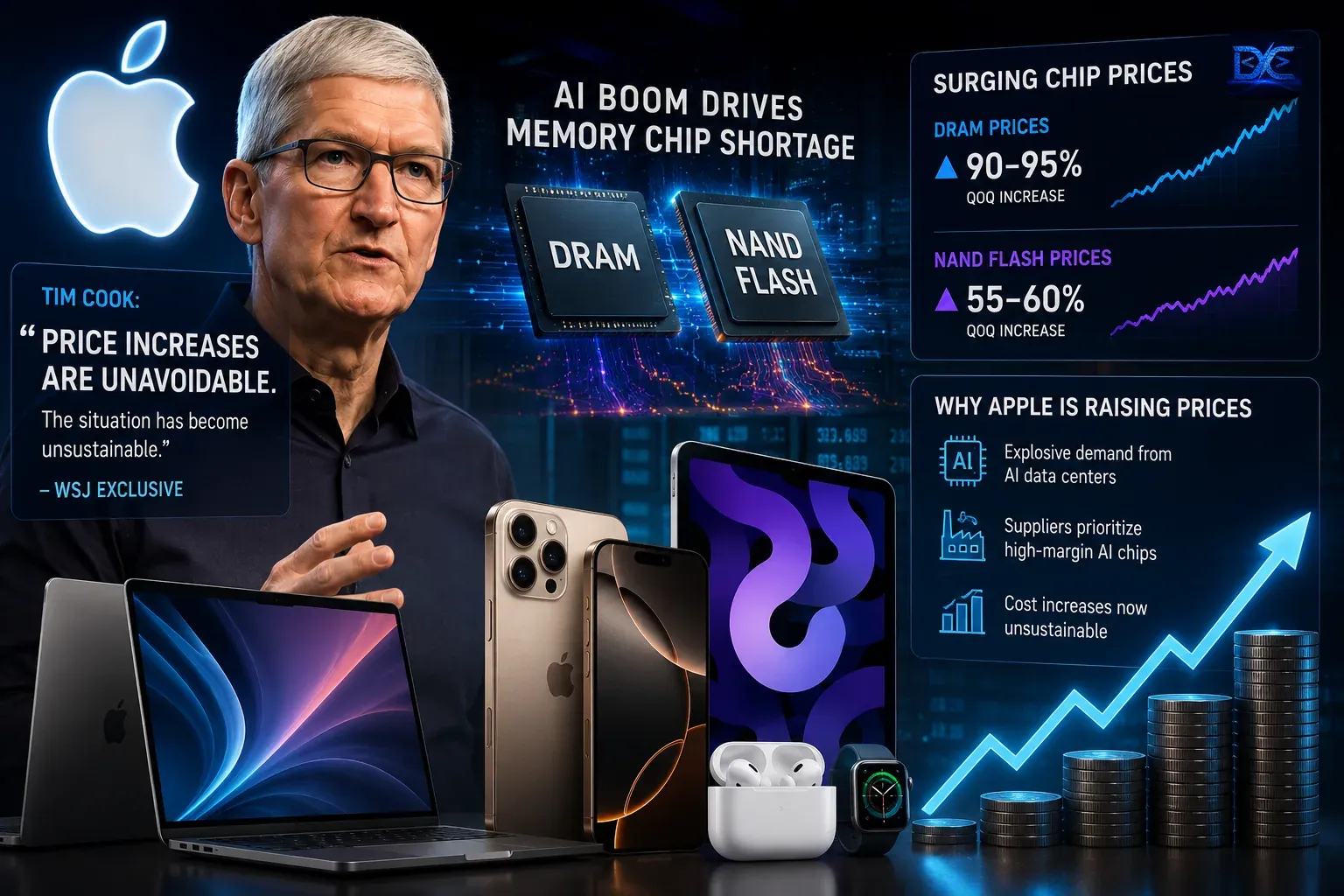
The warning became reality in about a week. After CEO Tim Cook said in mid-June that price increases were “unavoidable,” Apple raised prices on June 25, 2026 across much of its lineup — Macs, iPads, the HomePod, Apple TV and Vision Pro — blaming a “hundred-year flood” in memory (DRAM) and storage (NAND) chip costs driven by AI data-center demand. Notably, the iPhone, Apple Watch and AirPods were left untouched. Investors didn’t love it: AAPL fell about 5% on the day.
Recent and developing. Prices and the stock move below reflect the June 25, 2026 announcement and that day’s trading. Apple hinted more products could see adjustments later — treat specifics as point-in-time and verify against Apple’s store and a live quote.
What got more expensive
Apple’s statement put it plainly: “The rapid expansion of AI data centers has created an extraordinary surge in demand for memory and storage. We have never seen a component price increase this much, this quickly.” The increases ran roughly $100 to $500 per device, landing hardest on memory- and storage-heavy models.
| Product | Old | New |
|---|---|---|
| MacBook Air (base, 512GB) | $1,099 | $1,299 |
| MacBook Pro (14”, 1TB) | $1,699 | $1,999 |
| Mac Studio | $1,999 | $2,499 |
| iPad Air (128GB) | $599 | $749 |
| iPad Pro (11”) | $999 | $1,199 |
| HomePod | $299 | $349 |
| HomePod Mini | $99 | $129 |
| Apple TV | $99 | $129 |
| Vision Pro | $3,499 | $3,699 |
The pattern is clear: the more DRAM and NAND a device carries, the bigger the bump — which is why the Mac Studio jumped $500 while the Apple TV moved $30.
Why the iPhone was spared
Apple held iPhone prices steady, and Cook’s earlier framing explains it: iPhones are constrained mainly by their processing chips, not memory, so the DRAM/NAND spike hit Macs and iPads harder. Apple also hinted that further price adjustments are possible on additional products down the line — so the iPhone’s reprieve may be temporary. Analysts at TechInsights estimated the next iPhone Pro would need roughly a $270 increase to preserve current margins if Apple eventually passes the memory cost through.
Why this is happening: AI ate the memory supply
The root cause is explosive demand for memory from AI data centers — especially high-bandwidth memory (HBM) and the DRAM/NAND used in AI servers and training clusters.
- AI buyers are first in line. The four largest hyperscalers (Amazon, Microsoft, Alphabet, Meta) are projected to spend on the order of $750 billion on AI infrastructure in 2026, consuming memory supply.
- DRAM prices spiked hard. Trackers cited DRAM up sharply in early 2026 — figures ranged from roughly 50% to as much as ~98% quarter over quarter depending on the scope — with more increases forecast for the current quarter.
- NAND followed. Storage prices climbed steeply too, with some estimates near 90% QoQ for flash.
- Suppliers chase margin. Samsung, SK Hynix, and Micron are steering more output toward high-margin AI chips, squeezing supply for consumer electronics. (See Micron’s record AI-driven quarter for the supply-side picture.)
Apple had been absorbing much of this through inventory buffers and supplier negotiations — but those buffers depleted, which is what made further absorption “unsustainable.”
The Tim Cook setup
This wasn’t a surprise. In a Wall Street Journal interview published June 17, 2026, Cook had already laid the groundwork:
“This is a hundred-year flood. I’ve never seen anything like it in any area in over 40 years.” — Tim Cook
He added that “price increases are unavoidable,” that Apple had been “trying to shield our customers” but the situation had “become unsustainable,” and — on why Apple won’t just build its own memory fabs — “We can’t do everything. We know what we’re good at.” Instead, Apple says it will use its balance sheet to help secure memory supply.
The interview also came as Cook entered his final months as CEO, with John Ternus set to succeed him in September 2026.
Apple isn’t alone
This is an industry-wide squeeze, not an Apple-only problem. Samsung, Microsoft, Sony and Dell had already raised prices over the same shortage, and analysts have forecast 10–15% average price increases across parts of consumer tech as long as AI demand dominates memory output.
Why it matters
1. AI’s costs are leaking into consumer prices. This is the clearest example yet that the data-center buildout has second-order effects on everyday devices — you don’t have to buy a GPU to pay for the AI boom.
2. Memory is a shared, finite pool. DRAM and NAND fabs pivot toward whoever pays most. When that’s AI, consumer electronics get outbid — a structural dynamic, not a one-off shortage.
3. Even Apple has limits. A company famous for supply-chain leverage conceded it can no longer fully absorb the hit — and the ~5% stock drop shows investors reading the hikes as a margin and demand risk, not a quick fix.
Takeaway: Watch memory pricing as a leading indicator for consumer-tech costs. As long as AI demand dominates DRAM/NAND output, upward price pressure on devices is structural, not seasonal — and the iPhone may be next.
Bottom line
Apple did exactly what Tim Cook warned it would: it raised prices across Macs, iPads, the HomePod, Apple TV and Vision Pro on June 25, 2026, driven by a once-in-a- generation memory and storage crunch that AI data centers set off. The iPhone was spared — for now — but Apple left the door open to more. Investors marked the stock down about 5%.
For the exact current prices, check Apple’s store; for the margin impact, watch Apple’s next earnings call. For the original framing, see The Wall Street Journal.
Sources: Apple’s June 25, 2026 price announcement and statement, as reported by TechCrunch, Reuters, Bloomberg, CNBC, Gizmodo and MacRumors; the Wall Street Journal interview with Tim Cook (June 17, 2026); and memory-pricing data from TrendForce, Counterpoint and TechInsights. Prices, percentages and stock moves are point-in-time and evolving; verify before relying on them.
Related articles
Intel Jumps ~9% on Apple Chip Partnership: What's Behind the Surge
Intel shares spiked nearly 9% in pre-market on June 18, 2026 after President Trump said Apple has agreed to partner with Intel to design and make chips in the U.S. Here's what the deal reportedly involves, why it's a big deal for Intel's foundry turnaround, and the caveats worth keeping in mind.
Micron Crushes It: Record $41.5B Quarter Reignites the AI Chip Trade
Micron reported blockbuster fiscal Q3 2026 results on June 24, 2026 — record revenue of $41.46 billion (up ~346% YoY) and $25.11 non-GAAP EPS, both crushing estimates — then guided to a stunning ~$50 billion next quarter. Shares jumped ~15%, SK Hynix and Samsung rallied, and the whole HBM/AI memory trade got its confidence back. Here's the breakdown.
Amazon's Zoox Upgrades Its Robotaxi Ahead of Commercial Expansion
On June 24, 2026, Amazon-owned Zoox revealed comfort and design upgrades to its purpose-built, steering-wheel-free robotaxi — redesigned seats, relocated reflectors and two-way audio — ahead of a commercial launch later this year. Its Hayward plant can build up to 100 vehicles a week, scaling toward 10,000 a year, with paid rides pending NHTSA approval.
Have a project or an idea?
We don't just write about software — we build it. Tell us what you're working on and we'll get back within 1–2 business days.