AI-Rally Jitters: Tech Stocks Tumble as Micron Earnings Become the Big Test
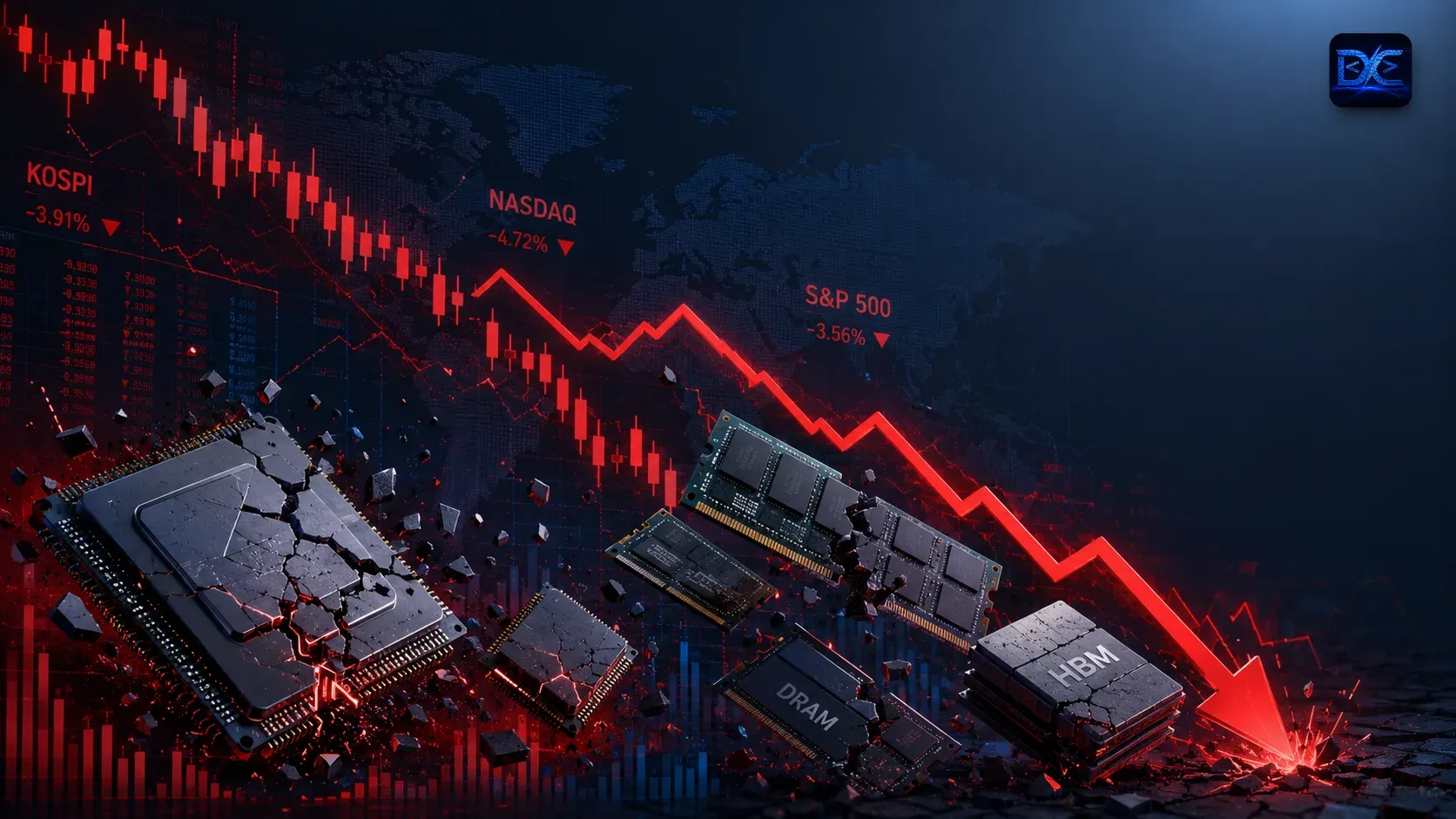
Tech stocks slid hard around June 24, 2026, with the Nasdaq 100 on track to shed over $1 trillion as Nvidia, AMD and Tesla led the selling. Investors treated Micron's Q3 report — due June 24 — as a pulse check on whether the AI memory boom can keep justifying record valuations. Here's what moved and why.

The AI trade got a reality check this week. Around June 24, 2026, major indices sold off hard — the Nasdaq 100 was on track to shed over $1 trillion in value — as investors dumped the AI winners that had carried the market. Nvidia, AMD and Tesla led the slide, and all eyes turned to one report to settle the nerves: Micron’s fiscal Q3 earnings, due June 24, now treated as a referendum on the durability of the AI boom.
Fast-moving story. Prices, percentages and earnings figures below are point-in-time around June 23–24, 2026, and markets are moving fast. Treat every number as a snapshot — check a live financial platform (tickers MU, NVDA, AMD, TSLA) before relying on it.
Update — June 25, 2026: the test passed. Micron’s report (after the close on June 24) was a blowout — record $41.46B revenue and a ~$50B next-quarter guide — and it sparked a rebound. SK Hynix jumped ~12–13% to a record, Samsung ~5.4%, and US indices steadied: the S&P 500 closed +0.5%, the Dow +0.65%, the Nasdaq +0.2% on June 25. The AI-memory thesis got its proof, at least for now. Full breakdown in Micron’s record AI-driven quarter.
At a glance
| Detail | |
|---|---|
| Trigger | AI-spending doubts + hawkish Fed repricing |
| Index move | Nasdaq 100 set to lose over $1 trillion in value |
| Nvidia | -4.1%, market cap dipping below $5 trillion |
| Tesla | -5.8% — a top drag outside the chip group |
| AMD | -5.2% |
| Other chips | Intel -6.8%, Micron -8%, SanDisk -9.2%, Western Digital -7.5% |
| The catalyst to watch | Micron Q3 earnings, June 24, 2026 |
What happened
After a relentless year-long run, the AI complex turned red across the board. Semiconductors took the worst of it: alongside Micron’s roughly 8% drop, Intel fell 6.8%, AMD 5.2%, SanDisk 9.2% and Western Digital 7.5%. Nvidia slipped 4.1%, briefly pushing its market cap below $5 trillion, while Tesla sank 5.8% as one of the biggest non-chip weights on the Nasdaq.
The damage spread beyond pure-play AI names. Alphabet lost about 2.1%, Amazon roughly 1% and Apple 0.4% — a combined hit of around $345 billion in market value if the losses held.
Why the mood turned
Two worries collided:
- AI-spend skepticism. Hyperscalers have committed billions to scale AI infrastructure, but there’s still little hard evidence those products are generating returns that justify the outlay. Earlier in the week, a report that SK Hynix was slowing expansion of AI memory chip production rattled the entire memory complex — if the people closest to demand are tapping the brakes, the bulls’ growth story gets harder to defend.
- A more hawkish Fed. Traders moved to price in roughly 50 basis points of rate hikes by December — up from expectations of a single 25-basis-point move just two weeks earlier. Higher-for-longer rates hit the long-duration, high-multiple names hardest, and that’s exactly where the AI leaders sit.
Why Micron is the test
Micron has been one of the purest expressions of the AI memory boom — and one of the most extended. The stock has soared roughly 727% over the past 12 months and is up about 270% since January, carrying its valuation toward the $1 trillion mark.
That run raised the stakes for its fiscal Q3 report on June 24. Consensus pointed to something like $20+ EPS on revenue near $35.5 billion, with the most aggressive models penciling in net income around $23.8 billion on $35.6 billion of revenue — year-over-year jumps that read more like a typo than an earnings line. Demand for high-bandwidth memory (HBM) from AI data centers is the engine.
The bear case is just as sharp: that $1 trillion valuation already prices in a new era of AI demand. If hyperscalers buy less HBM than expected — or learn to train models more efficiently — demand could soften before Micron’s new capacity comes online, leaving the stock badly over-its-skis.
Takeaway: Micron isn’t just reporting its own quarter — it’s standing in for the whole AI-memory thesis. A strong print with a confident outlook could steady the tape; any wobble on HBM demand could validate the week’s selling.
Why it matters
1. The leaders are now the risk. The same handful of AI mega-caps that drove the rally are concentrated enough that a few down days can erase $1 trillion-plus from an index. Concentration cuts both ways.
2. Memory is the tell. HBM sits at the center of the AI buildout. Signals from Micron and SK Hynix are leading indicators for the entire data-center capex cycle — watch them as closely as the GPU names.
3. The macro backdrop changed. A market repricing toward more Fed hikes removes some of the tailwind that let AI multiples expand. Rates and AI sentiment are now moving together.
The aftermath: a bounce, but the worries didn’t vanish
Micron’s blowout steadied the tape — but the volatility had deeper roots than one earnings date, and several of them are still live:
- Micron answered the memory question. Record $41.46B revenue, $28B quarterly profit, and a sold-out HBM book pushed the stock up ~15% after hours and lifted the whole memory complex (SK Hynix, Samsung, Kioxia). It reframed the week’s selling as a scare, not a thesis break — for memory at least.
- SpaceX was a hidden weight. Part of the prior Nasdaq air-pocket wasn’t AI at all: newly public SpaceX (SPCX) unwound hard after its record June IPO, shedding 16% in the June 23 session and erasing $600B+ in market cap from its peak — a reminder of how much froth had built up. (See our SpaceX IPO breakdown.)
- Oracle put a number on the AI labor story. Around June 22–23, Oracle disclosed it had cut roughly 21,000 roles (~13% of staff) over the past year, explicitly tying the reductions to AI adoption, while funding its own AI buildout with new debt. It’s the clearest sign yet that AI is reshaping headcount, not just capex.
- The macro overhang lingers. Sticky inflation, a more hawkish Fed, and geopolitical jitters mean the rate-sensitive AI leaders stay high-beta. One good print doesn’t reset any of that.
Bottom line
This was a sentiment reset, not necessarily a thesis break. The Nasdaq 100’s $1 trillion+ air-pocket reflects two things at once — doubts about AI returns and a more hawkish Fed — landing on names priced for perfection. Micron’s June 24 report is the near-term swing factor: blow-out numbers with a clean HBM outlook would argue the boom is intact; any crack would hand the bears their proof. For the live picture, check MU, NVDA, AMD and TSLA before trading on any figure here.
Sources: market-moving reports and analyst commentary around June 23–24, 2026, including Reuters, Yahoo Finance, Investing.com and 24/7 Wall St. Stock moves and earnings estimates are volatile and point-in-time; verify current quotes and the actual reported results before relying on them.
Related articles
Global Tech Selloff Deepens: Chip and AI Stocks Lead a Worldwide Rout
A broad tech rout swept global markets on June 23, 2026. South Korea's Kospi crashed ~10% on Samsung and SK Hynix, triggering a trading halt, before the selling hit Europe and the US — where memory and AI-chip names led the Nasdaq and S&P 500 lower. Here's what moved, why, and what to watch.

Micron Crushes It: Record $41.5B Quarter Reignites the AI Chip Trade
Micron reported blockbuster fiscal Q3 2026 results on June 24, 2026 — record revenue of $41.46 billion (up ~346% YoY) and $25.11 non-GAAP EPS, both crushing estimates — then guided to a stunning ~$50 billion next quarter. Shares jumped ~15%, SK Hynix and Samsung rallied, and the whole HBM/AI memory trade got its confidence back. Here's the breakdown.

Meta Bets on Prediction Markets ('Arena'); Qualcomm Buys Modular for ~$4B
Two AI-era power moves landed in late June 2026: Mark Zuckerberg directed Meta to build a prediction markets app codenamed 'Arena,' aiming at billions of users and rivals like Polymarket and Kalshi. Separately, Qualcomm is acquiring AI software startup Modular — maker of the Mojo language and MAX engine — in an all-stock deal worth nearly $4 billion to challenge Nvidia's CUDA moat.
Have a project or an idea?
We don't just write about software — we build it. Tell us what you're working on and we'll get back within 1–2 business days.