OpenAI's Q1 2026: $5.7B Revenue, $3.7B Burn — Growth at All Costs
OpenAI's first quarter of 2026 shows revenue and cash burn both roughly tripling year over year. Here's a clear, no-jargon look at the numbers, where the money goes, why the burn is so high, and what it means for the road to profitability.
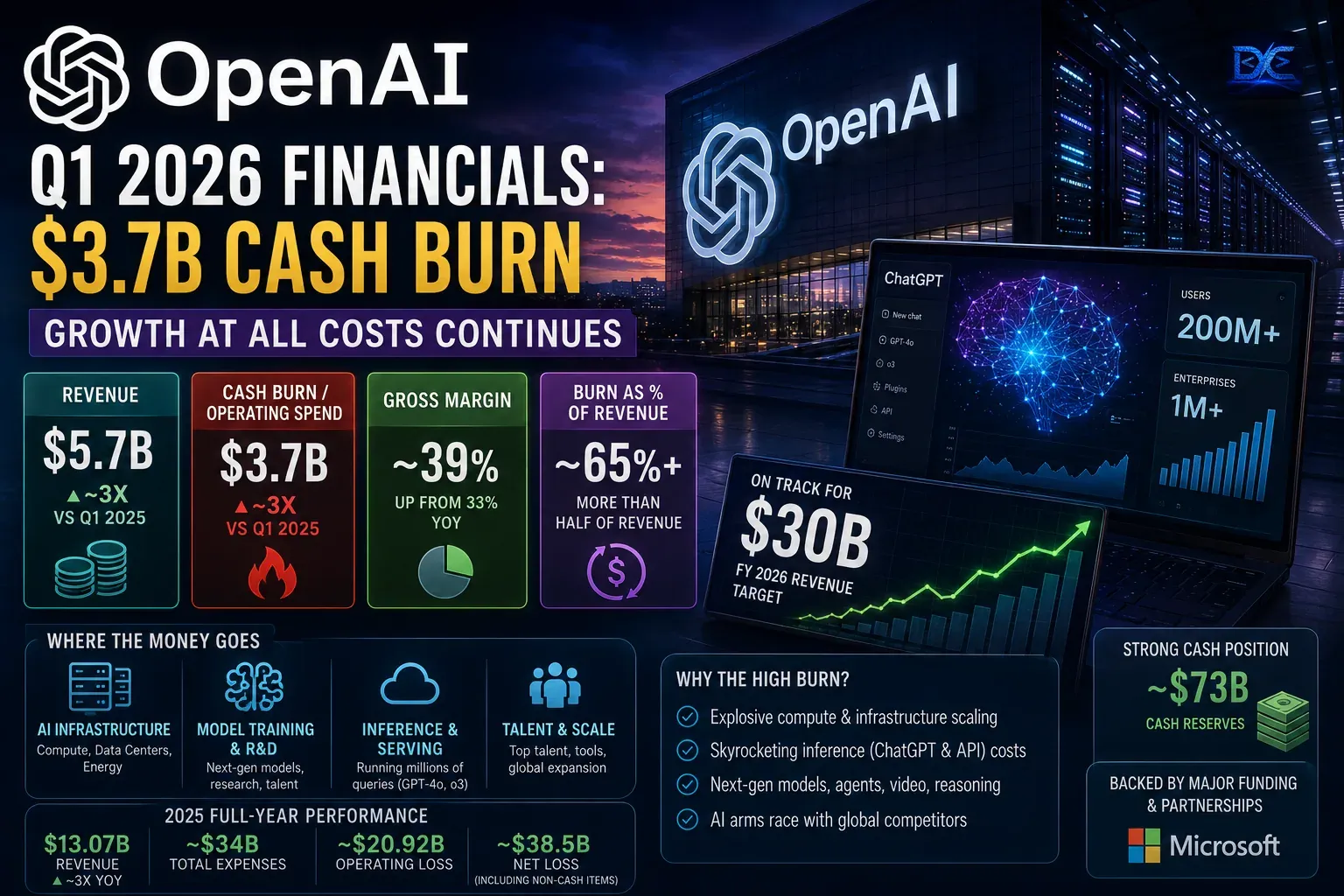
OpenAI’s latest numbers tell a clear story: massive growth, paid for with massive spending. In the first quarter of 2026, the company brought in $5.7 billion in revenue while burning through about $3.7 billion — more than half of what it earned. Both figures roughly tripled compared to the same quarter in 2025.
This is the classic “growth at all costs” phase of a frontier AI lab. Let’s break down the numbers in plain language.
About the figures: These come from reporting on documents shared with shareholders. Treat exact numbers as directional — they can be revised, and private-company finances are never the full picture.
The Q1 2026 numbers at a glance
| Metric | Q1 2026 | Note |
|---|---|---|
| Revenue | $5.7B | ~3× vs. Q1 2025 |
| Cash burn / operating spend | $3.7B | ~3× vs. Q1 2025; more than half of revenue |
| Gross margin | ~39% | up from ~33% a year earlier |
| Cash reserves | ~$73B | a large cushion, per recent reports |
The improving gross margin (33% → 39%) is a good sign: each dollar of revenue is getting a little more efficient. But the burn is still enormous in absolute terms.
Where the money goes
The $3.7 billion isn’t waste — it’s the cost of building and running frontier AI:
- AI infrastructure: compute, data centers, and energy
- Model training & R&D: building the next generation of models
- Inference (serving): running millions of queries on models like GPT-4o and o3, every day
- Talent & scale: top researchers, tooling, and global expansion
Why is the burn so high?
A few forces push spending up fast:
- Explosive compute scaling for next-gen models (think GPT-5-class systems, agents, video, and reasoning).
- Skyrocketing inference costs — serving huge numbers of ChatGPT and API users is expensive, and usage keeps climbing.
- The AI arms race — competing with Anthropic, Google, xAI, and Meta means you can’t slow down on capability.
- Energy and data-center buildouts plus aggressive talent acquisition.
In short: the more popular the products get, the more it costs to run them — and the race forces continued heavy investment.
The bigger picture: 2025 full year
To put Q1 in context, here’s how 2025 looked:
| Metric (FY 2025) | Value |
|---|---|
| Revenue | ~$13.07B (about 3× vs. 2024) |
| Total expenses | ~$34B |
| R&D | ~$19.18B |
| Operating loss | ~$20.92B |
| Net loss (incl. non-cash items) | ~$38.5B |
OpenAI is reportedly on track for a $30 billion full-year 2026 revenue target. But if current margins hold, annual losses could still exceed $36 billion — which is why the path to profit is the big question.
What it means going forward
- Revenue is real and growing fast, led by ChatGPT subscriptions (Plus, Team, Enterprise) and API usage by developers and businesses.
- Profitability is years away. The company has signaled sustainable profit is a later-decade goal (2029+), and is exploring new revenue like ads in ChatGPT alongside cost optimization.
- IPO talk is in the air, with reports of a potential trillion-dollar-plus valuation — but high burn raises fair investor questions about the road to durable profits.
- A strong cash position (~$73B) and deep partnerships (notably Microsoft) give it room to keep spending for now.
Takeaway: Frontier AI is incredibly capital-intensive. Revenue tripling is impressive, but so is the burn. The companies that win will be the ones that turn scale into efficiency before the money — or investor patience — runs out.
Bottom line
OpenAI’s Q1 2026 is a snapshot of the entire AI moment: huge demand, huge revenue, and even huger costs. Margins are improving and the cash pile is large, but the core challenge remains turning explosive growth into a sustainable business. With new models, funding rounds, and possibly an IPO ahead, expect these numbers to keep moving fast.
Related articles

Micron Crushes It: Record $41.5B Quarter Reignites the AI Chip Trade
Micron reported blockbuster fiscal Q3 2026 results on June 24, 2026 — record revenue of $41.46 billion (up ~346% YoY) and $25.11 non-GAAP EPS, both crushing estimates — then guided to a stunning ~$50 billion next quarter. Shares jumped ~15%, SK Hynix and Samsung rallied, and the whole HBM/AI memory trade got its confidence back. Here's the breakdown.

AI-Rally Jitters: Tech Stocks Tumble as Micron Earnings Become the Big Test
Tech stocks slid hard around June 24, 2026, with the Nasdaq 100 on track to shed over $1 trillion as Nvidia, AMD and Tesla led the selling. Investors treated Micron's Q3 report — due June 24 — as a pulse check on whether the AI memory boom can keep justifying record valuations. Here's what moved and why.

Global Tech Selloff Deepens: Chip and AI Stocks Lead a Worldwide Rout
A broad tech rout swept global markets on June 23, 2026. South Korea's Kospi crashed ~10% on Samsung and SK Hynix, triggering a trading halt, before the selling hit Europe and the US — where memory and AI-chip names led the Nasdaq and S&P 500 lower. Here's what moved, why, and what to watch.
Have a project or an idea?
We don't just write about software — we build it. Tell us what you're working on and we'll get back within 1–2 business days.