Nvidia's Next-Gen 'Kyber' AI Rack Slips to 2028 on a 78-Layer Snag
Nvidia's Kyber (NVL144) rack system — built to house its 2027 Rubin Ultra chips — is reportedly delayed by more than 12 months to 2028 on PCB manufacturing snags, per SemiAnalysis. A 78-layer midplane and a rejected backup plan are at the center. Here's the delay, the cause, and why AMD and Google get an opening.
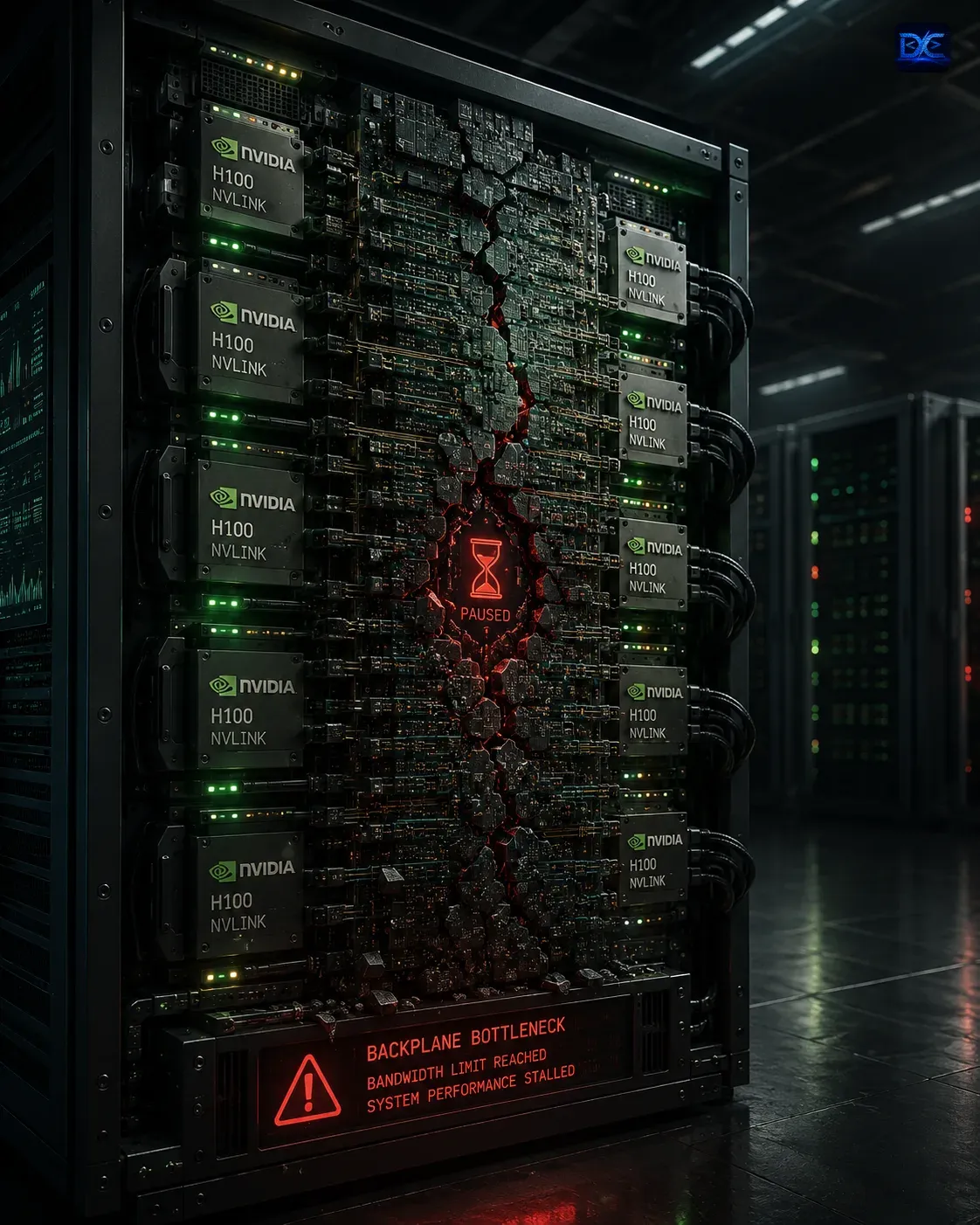
Nvidia’s annual release cadence just hit a physical wall. Its next-generation Kyber rack system — the NVL144 cabinet designed to house the Rubin Ultra chips due in 2027 — has reportedly slipped by more than 12 months, to 2028, according to research firm SemiAnalysis. The culprit isn’t silicon but the circuit board: a midplane so complex it’s proven brutally hard to manufacture. The delay hands rivals AMD and Google a rare opening at the very top of the AI market.
Fast-moving story. The delay is based on SemiAnalysis reporting relayed around July 6, 2026; Nvidia had not publicly confirmed a revised timeline. Treat dates and details as point-in-time.
At a glance
| Detail | |
|---|---|
| Product | Kyber rack-scale system (NVL144) |
| Houses | Rubin Ultra chips (due 2027) |
| Original timeline | 2027 |
| New timeline | 2028 (12+ month slip) |
| Root cause | PCB midplane — reportedly 78 layers |
| Backup plan | Scrapped after cloud providers rejected it |
| Source | SemiAnalysis |
| Beneficiaries | AMD, Google |
What went wrong
Kyber is an ambitious redesign of the AI rack: GPUs mount in vertical compute trays rather than horizontally, packing in more density and cutting latency between chips. But that density runs through a midplane — the backbone board that interconnects the trays — and this one is reportedly a 78-layer PCB, among the most complex circuit boards ever designed for a commercial computing product.
That complexity is the bottleneck. Manufacturing a board with that many layers at yield and scale has proven far harder than expected, pushing the whole rack’s timeline out past 2027.
The backup that fell through
Nvidia reportedly had a fallback rack design ready in case the primary Kyber architecture ran into trouble. But major cloud customers rejected it as awkward and costly to operate, and the backup was scrapped. With no acceptable Plan B, the delay to 2028 became the path forward.
Why AMD and Google get an opening
At the high end of AI infrastructure, Nvidia’s edge has been the full rack-scale system, not just the GPU. A 12-month gap in that roadmap is exactly the kind of window competitors need:
- AMD has been pushing its own rack-scale AI systems and could court customers who can’t wait for Kyber.
- Google, with its in-house TPU infrastructure, offers an alternative path for hyperscalers building at the frontier.
Importantly, the near-term financial hit may be muted — SemiAnalysis still projects Nvidia’s data-center compute revenue running well ahead of Wall Street in the second half of fiscal 2027. The risk is strategic, not immediate: a rare crack in the roadmap that rivals can try to pry open.
Why it matters
1. Cadence is colliding with physics. Nvidia’s yearly release rhythm depends on suppliers keeping up. A 78-layer midplane shows how packaging and PCB complexity — not just chips — now gate AI hardware.
2. Rack-scale is the real product. The delay is about the system, not the silicon. It’s a reminder that at the frontier, Nvidia sells cabinets and interconnects as much as GPUs.
3. A rare opening for challengers. A year is a long time in AI. AMD and Google don’t get many chances to win frontier customers on timing — this is one.
Bottom line
Nvidia’s Kyber (NVL144) rack — the home for its Rubin Ultra chips — is reportedly slipping to 2028, undone not by chip design but by a 78-layer midplane that’s punishing to build, with a rejected backup plan sealing the delay. Near-term revenue looks fine; the longer-term question is whether AMD and Google can turn a 12-month gap into real frontier share before Nvidia’s rack catches up.
Sources: CNBC and SemiAnalysis reporting (via Seeking Alpha, MLQ and The Next Web) on Nvidia’s Kyber rack delay, relayed around July 6, 2026. Nvidia had not confirmed a revised timeline publicly; details are point-in-time.
Related articles

Meta Bets on Prediction Markets ('Arena'); Qualcomm Buys Modular for ~$4B
Two AI-era power moves landed in late June 2026: Mark Zuckerberg directed Meta to build a prediction markets app codenamed 'Arena,' aiming at billions of users and rivals like Polymarket and Kalshi. Separately, Qualcomm is acquiring AI software startup Modular — maker of the Mojo language and MAX engine — in an all-stock deal worth nearly $4 billion to challenge Nvidia's CUDA moat.

OpenAI's First Custom Chip: 'Jalapeño,' Built With Broadcom for LLM Inference
OpenAI and Broadcom unveiled Jalapeño on June 24, 2026 — OpenAI's first custom AI accelerator, designed in-house for LLM inference and manufactured by Broadcom. Co-developed from design to tape-out in nine months, it reportedly cuts inference costs ~50% versus typical AI GPUs, with first deployment targeted by end of 2026. Here's what it means for OpenAI's Nvidia reliance.

AI-Rally Jitters: Tech Stocks Tumble as Micron Earnings Become the Big Test
Tech stocks slid hard around June 24, 2026, with the Nasdaq 100 on track to shed over $1 trillion as Nvidia, AMD and Tesla led the selling. Investors treated Micron's Q3 report — due June 24 — as a pulse check on whether the AI memory boom can keep justifying record valuations. Here's what moved and why.
Have a project or an idea?
We don't just write about software — we build it. Tell us what you're working on and we'll get back within 1–2 business days.