Global Tech Selloff Deepens: Chip and AI Stocks Lead a Worldwide Rout
A broad tech rout swept global markets on June 23, 2026. South Korea's Kospi crashed ~10% on Samsung and SK Hynix, triggering a trading halt, before the selling hit Europe and the US — where memory and AI-chip names led the Nasdaq and S&P 500 lower. Here's what moved, why, and what to watch.
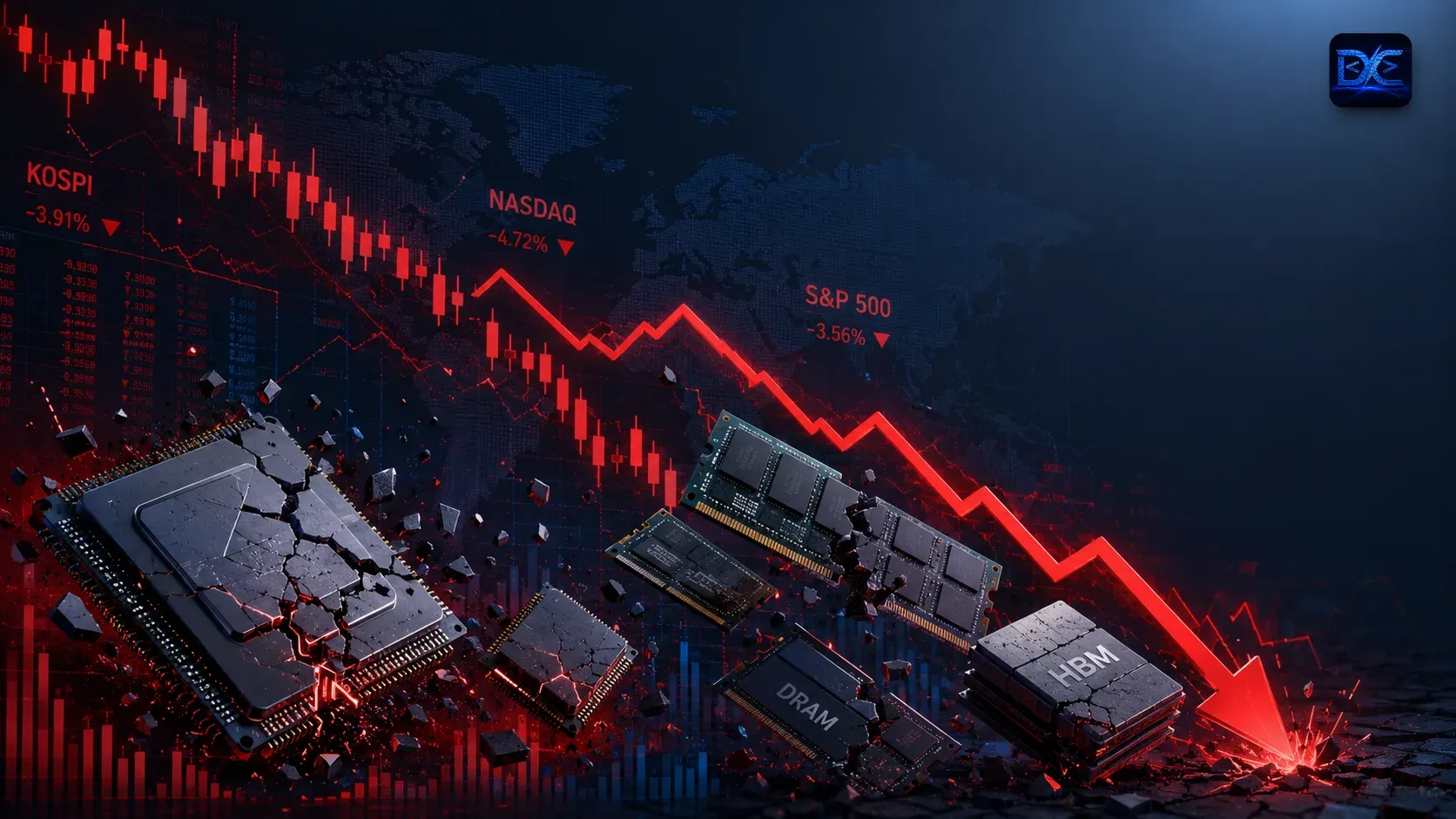
A global tech selloff intensified on Tuesday, June 23, 2026, with chip and memory stocks taking the worst of it. It started in Asia — where South Korea’s Kospi crashed roughly 10% on heavy selling in Samsung and SK Hynix — and rolled westward through Europe and into the US, dragging the Nasdaq and S&P 500 lower. The trigger isn’t one headline but a cluster of worries: AI spending sustainability, stretched valuations, and a less dovish Fed.
Fast-moving story. Figures below reflect intraday and closing prints around June 23, 2026 and markets are volatile — numbers move fast and were revised through the session. Treat them as point-in-time and check a live financial platform for the current quote.
At a glance
| Move (≈) | |
|---|---|
| Kospi (South Korea) | ~10% down — triggered an intraday trading halt |
| Samsung / SK Hynix | ~12%+ down each |
| Nasdaq (Composite/100) | ~2% down, second straight losing session |
| S&P 500 | ~1.5% down |
| Semiconductor ETF (SOX-type) | ~6% down |
| Stoxx 600 (Europe) | ~1% down; tech subindex ~3% down |
What happened in Asia
The selloff’s epicenter was Seoul. The tech-heavy Kospi fell about 10%, with both Samsung Electronics and SK Hynix — the world’s dominant memory makers — down more than 12%. The drop was steep enough that the Korea Exchange triggered a trading halt (a roughly 20-minute “sidecar”/circuit-breaker pause) to cool the selling.
Why these two names matter: Samsung and SK Hynix sit at the heart of the AI hardware supply chain through high-bandwidth memory (HBM) and DRAM — the chips that feed AI accelerators. When sentiment on AI demand wobbles, they’re among the first to get hit.
The US session
By the time US markets opened, the risk-off mood had carried over. The Nasdaq slid around 2% and the S&P 500 about 1.5%, with semiconductors leading the declines:
- Micron (MU) tumbled as much as ~11% before paring losses — a sharp retreat from record highs, with extra nerves ahead of its earnings.
- Qualcomm fell ~8.6% and Arm Holdings about ~8.4%.
- Intel dropped ~7.6%, AMD roughly ~6.2%.
- Nvidia slipped around ~3% — comparatively resilient, but still red.
Europe wasn’t spared either: the pan-European Stoxx 600 shed about 1%, with its technology subindex down ~3%.
What’s driving it
This is less a single shock than several pressures landing at once:
1. AI spending sustainability. After a multi-year, capex-fueled run, investors are questioning how long hyperscaler AI buildout can keep accelerating — and whether the returns justify the spend. Any hint that the curve flattens hits chip and memory names first.
2. Stretched valuations. Many AI and semiconductor stocks were sitting at or near record highs. Rich multiples leave little margin for error, so profit-taking turns into a fast unwind once momentum reverses.
3. A less dovish Fed. Recent Fed signaling that inflation remains sticky trimmed expectations for near-term rate cuts. Higher-for-longer borrowing costs weigh most on long-duration, high-growth tech.
4. Pre-earnings jitters. With Micron set to report, some of the selling read as anxiety ahead of memory results — a key tell for the AI-memory trade. As JPMorgan analysts noted, nervousness around that print added to the pressure.
Why it matters
Concentration cuts both ways. The same AI-and-chip leadership that powered indices to record highs now amplifies the downside. When a handful of mega-cap and semiconductor names dominate the tape, a rotation out of them moves the whole market.
The memory cycle is a signal. Samsung, SK Hynix and Micron are leveraged to HBM/ DRAM demand. Their moves are a real-time read on how the market is pricing AI hardware appetite — watch them, not just the index level.
Macro still rules. Rate-cut expectations remain the swing factor. Until the Fed path clarifies, expect elevated volatility in the most rate-sensitive corners of tech.
Bottom line
A worldwide tech rout — led by memory and AI-chip stocks, sparked in Asia by a ~10% Kospi crash, and carried into a lower Nasdaq and S&P 500 — is a classic “gut check” moment for the AI trade. The drivers (AI-capex doubts, valuations, the Fed) are interconnected, and a single earnings print or Fed comment could swing sentiment either way.
If you hold exposure here, this is a reminder that AI leadership is a high-beta bet: big on the way up, and just as quick on the way down. For the latest levels, check a financial platform for the relevant tickers (e.g., MU, NVDA, AMD, and the Kospi).
Sources: market reporting for June 23, 2026 (CNBC, NBC News, TheStreet, Yahoo Finance, Bloomberg) and analyst commentary, including JPMorgan. Prices are volatile and point-in-time; verify the current quote before relying on it.
Related articles

AI-Rally Jitters: Tech Stocks Tumble as Micron Earnings Become the Big Test
Tech stocks slid hard around June 24, 2026, with the Nasdaq 100 on track to shed over $1 trillion as Nvidia, AMD and Tesla led the selling. Investors treated Micron's Q3 report — due June 24 — as a pulse check on whether the AI memory boom can keep justifying record valuations. Here's what moved and why.

Micron Crushes It: Record $41.5B Quarter Reignites the AI Chip Trade
Micron reported blockbuster fiscal Q3 2026 results on June 24, 2026 — record revenue of $41.46 billion (up ~346% YoY) and $25.11 non-GAAP EPS, both crushing estimates — then guided to a stunning ~$50 billion next quarter. Shares jumped ~15%, SK Hynix and Samsung rallied, and the whole HBM/AI memory trade got its confidence back. Here's the breakdown.

Meta Bets on Prediction Markets ('Arena'); Qualcomm Buys Modular for ~$4B
Two AI-era power moves landed in late June 2026: Mark Zuckerberg directed Meta to build a prediction markets app codenamed 'Arena,' aiming at billions of users and rivals like Polymarket and Kalshi. Separately, Qualcomm is acquiring AI software startup Modular — maker of the Mojo language and MAX engine — in an all-stock deal worth nearly $4 billion to challenge Nvidia's CUDA moat.
Have a project or an idea?
We don't just write about software — we build it. Tell us what you're working on and we'll get back within 1–2 business days.